



Private REITs: What They Are and Why Canadian Investors Are Taking Notice

Even amid geopolitical tension and rate volatility, 81% of institutional investors expect 2026 to be a particularly good year for private markets.1
That optimism isn't new for pensions and endowments, which have used private real estate, private equity, and private credit for diversification for decades. What’s new is who else gets to participate: regulatory changes over the past decade and new fund structures have put private markets, particularly private real estate, within reach of everyday Canadian investors. 2
Many investors are still getting oriented with what a private REIT actually is, how it works, and what role it might play alongside a traditional portfolio of stocks and bonds. That's the ground this piece covers.
1. Public and Private Markets, in Practice
Public Markets
Stocks and bonds are bought and sold on public exchanges, with prices visible in real time against the latest economic data, interest rate decisions, and market sentiment. That’s not theoretical: in June 2026, the TSX dropped 2.3% in a single trading day after stronger than expected jobs data shifted the market’s rate-cut expectations. 3 This serves as a reminder of how quickly public markets reprice on economic data and forward-looking bets, not just on how the underlying businesses are performing. That constant repricing has an upside — liquidity and transparency — as well as a cost: valuations can move on headlines and sentiment as much as on fundamentals.
Private Markets
Private market assets — private real estate, private equity, and other alternatives — aren't traded on an exchange and aren't usually repriced daily. Instead, they're typically valued periodically based on the actual performance of the underlying asset: the income it generates, occupancy, and other operating metrics. That means their value tends to reflect what the asset actually produces, rather than how the market feels on a given day. Capital is also generally committed for a defined holding period, rather than traded daily.
That structural difference matters forportfolio construction. Since private assets are valued on performance ratherthan daily sentiment, they've historically tended to experience less volatilityand move somewhat independently of public stocks and bonds, contributing togenuine diversification (spreading capital across assets that don't all riseand fall together) rather than variety for its own sake.
Independence between private and public assets is one thing, but stocks and bonds don't always move independently of each other, and that's the harder lesson. In 2022,Canadian investors felt it firsthand: while equities declined, bonds —traditionally the stabilizing force in a balanced portfolio — fell approximately 12.66%, their worst year on record.4
2. Opening the Door to Private Markets
Private market investing isn’t a new idea. Institutions have been benefiting from this for decades. What’s new is individual access. Over the past decade, Canadian regulatory changes and new fund structures have lowered the investment minimums and structural barriers that once made private markets the exclusive domain of institutions.2 For investors, that’s a meaningful shift. Private markets offer something public portfolios structurally cannot: exposure that doesn’t rise and fall with the market’s daily mood. As more pathways to private asset investing become available to Canadian retail investors, what was once an exclusive corner of the investment world is becoming a standard part of modern portfolio construction. Incorporating private assets into portfolios offers the potential for a more balanced, risk-adjusted return.
For Canadian investors, this access is arriving at a meaningful time. 2022 was a reminder that stocks and bonds don't always move independently. Private assets, real estate in particular, are increasingly part of how a resilient portfolio gets built. Incorporating private assets isn't just about checking a box for variety: done well, it may improve a portfolio's risk-adjusted return — the return an investment generates relative to the risk taken to achieve it, a useful lens for comparing investments with different risk profiles.
3. The Case for Private Real Estate
How Private REITs Actually Work
A private REIT generates returns through owning and operating properties. Private real estate is distinct from public markets in part because it operates on its own economic cycle: value is driven by the performance of the underlying real estate (rental income, occupancy, and property value) rather than by trading activity. Investors pool capital into the fund; a manager acquires and manages a portfolio of properties on their behalf and distributes income, typically on a regular schedule and sometimes in a tax-efficient structure. Some private REITs are structured so they can beheld in registered accounts like RRSPs and TFSAs, adding a further layer of tax efficiency for eligible investors.² This provides investors with exposure to real estate returns without the responsibilities of direct property ownership.
Not all private REITs are built the same way, and the differences are exactly what a diligent investor should be asking about: the manager's track record, whether operations are handled in-house or outsourced, the fund's stated strategy — including property type and target markets — and the fee and redemption terms attached to the fund.
Public vs. Private REITs
Both public and private REITs invest in real estate — the difference lies in how they're priced, traded, and valued.
The Role of Private Real Estate in a Portfolio
Morningstar research indicates that adding REITs to a portfolio can improve return for a given level of risk.5Private real estate has historically offered three characteristics that help explain why:
- Income & return potential: Private REITs normally target distributions and growth, offering the potential to compound over time, without the responsibilities of direct ownership.
- Potential for inflation protection: Rents and property values have historically tended to increase alongside the cost of living. This means private real estate may generate income that holds its value over time, even as inflation puts pressure on other parts of a portfolio.
- Portfolio resilience & diversification: Incorporating private real estate into a portfolio has the potential to reduce overall volatility while maintaining return potential. This may contribute to a more resilient portfolio, and one that is better positioned during periods of broad market stress.
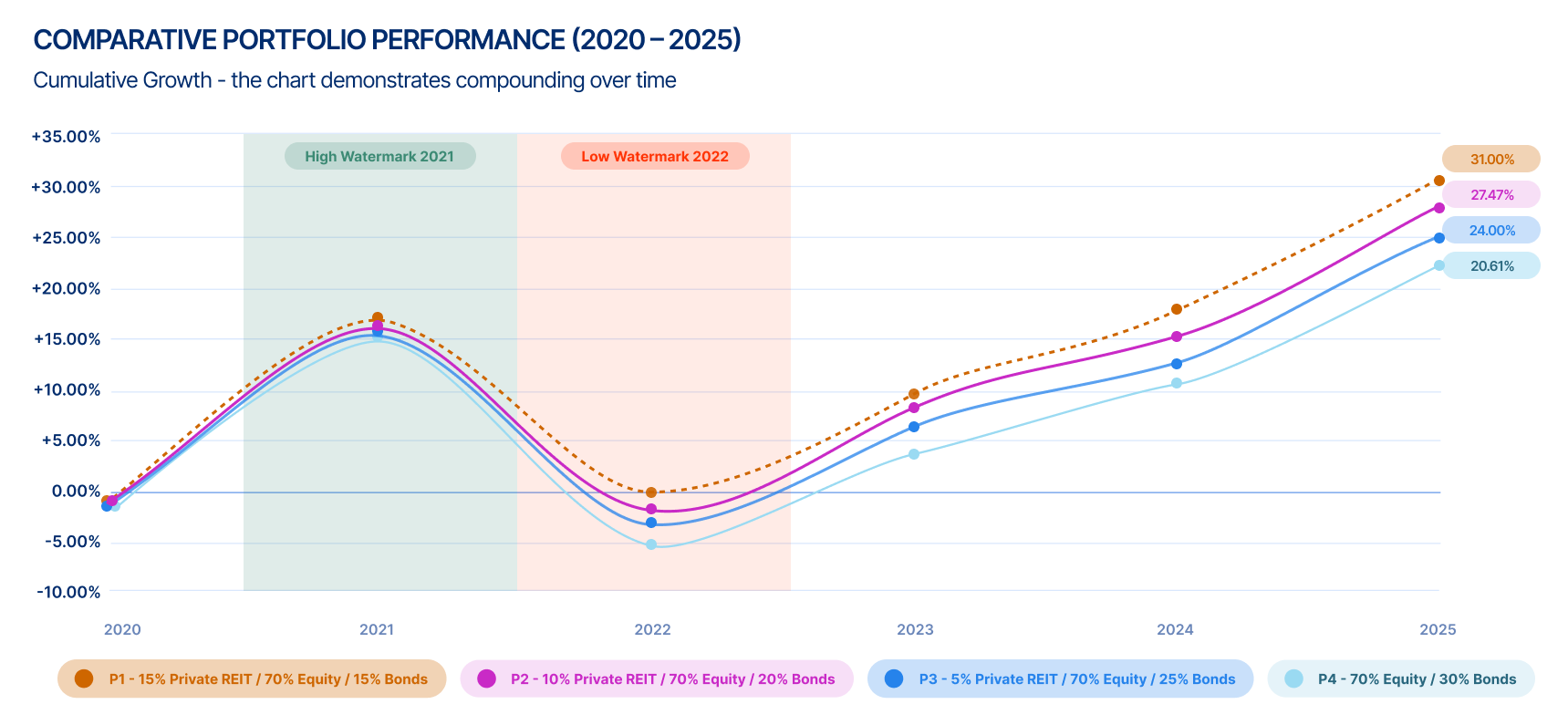
The chart below compares the historical performance of a traditional portfolio against portfolios that included a private real estate allocation from 2020–2025. The gap that appears in 2022 is the clearest illustration of the diversification benefit in practice.
Important Disclosures
Pier 4 Real Estate Investment Trust internal data and analysis. Returns are calculated monthly, as reported on the last day of trading each month, for the period identified, based on an initial NAV of $10.00. Returns represent the highest and lowest annualised total returns since inception to December 31,2025. Scenarios presented are hypothetical and intended for illustrative purposes only.
Indices information is retrieved from BlackRock (iShares), Vanguard Canada and Global X. Indices presented are well-known and widely recognised benchmarks and are meant to illustrate general market or sector performance. Investors should be aware of the risks and limitations with any comparisons to such benchmarks, including: (i) it is not possible to invest directly into an index; (ii)appraisal-based valuations of private real estate may be subject to smoothing bias and may therefore reflect lower volatility than would the valuation of public securities traded on an exchange; (iii) exempt market securities are generally priced less frequently than securities traded in the public markets, which may understate the relative volatility and correlation attributable to those securities; and (iv) units of the Trust are not listed or posted on any recognized exchange and are further subject to a number of restrictions respecting transferability and resale. This material does not consider the potential impact that currency fluctuations may have on asset or portfolio returns or the standard deviation (volatility) of such returns. Past performance is not indicative of future results. Current and future results may differ from those shown. This material does not constitute investment advice and is intended for use by registered dealers and exempt market dealers only. Please see the Offering Memorandum dated May 1, 2026 for full details, including the risk factors identified therein.
4. The Bottom Line
A resilient portfolio considers private markets, and private real estate, specifically. Private real estate has historically offered income, inflation protection, and a return profile of its own — exactly the kind of diversification 2022 proved matters.
What's new isn't the asset class. It's who can own it.
References
- Benefits Canada. (2025, December 22). 73% of global institutional investors have positive expectations for 2026: survey. https://www.benefitscanada.com/canadian-investment-review/research-markets/73-of-global-institutional-investors-have-positive-expectations-for-2026-survey/
- Osler, Hoskin & Harcourt LLP. (2024, December 5). The rise of retail: accessing private markets. https://www.osler.com/en/insights/reports/2024-legal-outlook/the-rise-of-retail-accessing-private-markets/
- BBN Times. (2026, June 9). Toronto Stock Exchange (TSX) Trades Around 34,093 on9 June 2026 as Bank of Canada Rate Decision and Oil Prices Dominate. https://www.bbntimes.com/companies/toronto-stock-exchange-tsx-trades-around-34-093-on-9-june-2026-as-bank-of-canada-rate-decision-and-oil-prices-dominate
- Guardian Capital. (2024, August 9). Bonds – Is the worst behind us? https://www.guardiancapital.com/investmentsolutions/insights/bonds-is-the-worst-behind-us/
- Morningstar.(n.d.). The role of real estate investments in a portfolio. https://www.morningstar.com/funds/role-real-estate-investments-portfolio
Acquisition Post
