



Canada’s Housing Gap: The Opportunity in Existing Apartments
Canada needs more homes. New development isn’t keeping pace. Existing apartment buildings have a critical role to play in Canada’s housing supply.
The country is facing a long-term housing challenge: significantly more homes are needed than we are on track to build.1 At the same time, homeownership is becoming less attainable and rental household formation is therefore expected to continue growing.3
That creates an increasingly essential role for the housing we already have.
1. Canada Isn’t Building Enough Homes
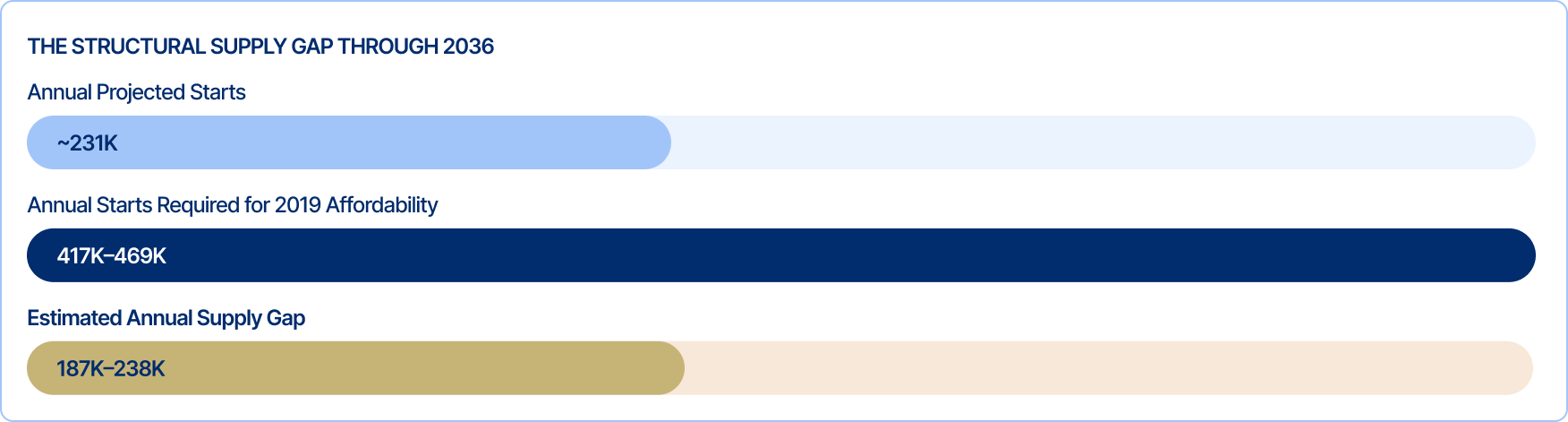
Canada needs almost double the number of homes it’s projected to build, to restore affordability in the country to pre-pandemic levels. Current projections sit at 231,000 homes and the actual number of annual housing starts needed to achieve those levels is 417,000-469,000 through 2036.1
The pressure on new construction is derived from higher costs, weaker presale demand, and challenging development economics.1,4 Construction is expected to continue slowing, with the pipeline showing even further pressure: actual housing starts fell 19% year-over-year in July 2026 in Canadian centres with populations of over 10,000.2
2. Demand Isn’t Slowing Down Either
Canada's housing requirement already exceeds its projected construction trajectory. This is a gap that exists regardless of how fast the population grows.¹ At the same time, the immigration conversation is shifting: Prime Minister Mark Carney has suggested Canada's immigration system is now "under control," with discussion turning toward when a controlled increase in population might resume.¹⁰ Canada currently targets approximately 380,000 permanent residents annually, down from a prior federal goal of 500,000 — a target reportedly back under discussion.¹⁰
If population growth were to accelerate again, even back toward that prior 500,000 target, it would add roughly 120,000 more newcomers per year — about 32% above today's target — onto a housing system that's already falling short.
We're not building enough homes today. Any future acceleration in population growth would only widen that gap further.
3. The Rental Market Is Shifting, But the Underlying Gap Isn't
As supply is constrained, prices rise, making it increasingly difficult for Canadians to own homes. Over half (56%) of Canadians who don’t own a home, don’t believe they will ever become homeowners.12 This is the highest rate among all 22 surveyed countries and more than double the global average.12
Rental household formation is therefore expected to continue in 2026, with younger Canadians leading this trend, as they are more likely to rent due to economic uncertainty and the relative affordability of renting compared to ownership.3
Rental market pressure has eased somewhat overall, but unevenly: vacancy has risen in newer, higher-priced buildings, while older, more affordable rental segments — where the majority of renters are competing for units — remain comparatively tight.³ While near-term rental conditions have evolved, the longer-term supply imbalance Pier 4 has been highlighting remains.
4. What Isn't Built Today Won't Become Housing Tomorrow
We are experiencing a housing shortage today without a solution in sight. Housing starts that are delayed or cancelled reduce visibility into the supply pipeline in the coming years. This outlook is backed by the data – CMHC is expecting construction to slow faster than future demand, creating the risk that Canada underbuilds today and finds itself further short of housing when demand strengthens.¹
Meanwhile, Canadians still need somewhere to live.

5. We’ve Seen Something Like This Before
The supply shortage behind the country’s rental housing isn’t without precedent. Canada has faced comparable conditions before.
In the early 2020s, purpose-built rental completions failed to keep pace with demand, leading to a tightening in the rental market.⁵ That tightening pushed vacancy rates to their lowest levels in decades, and combined with worsening housing affordability, sparked a sharp rise in rental demand and rent rates.5, 6
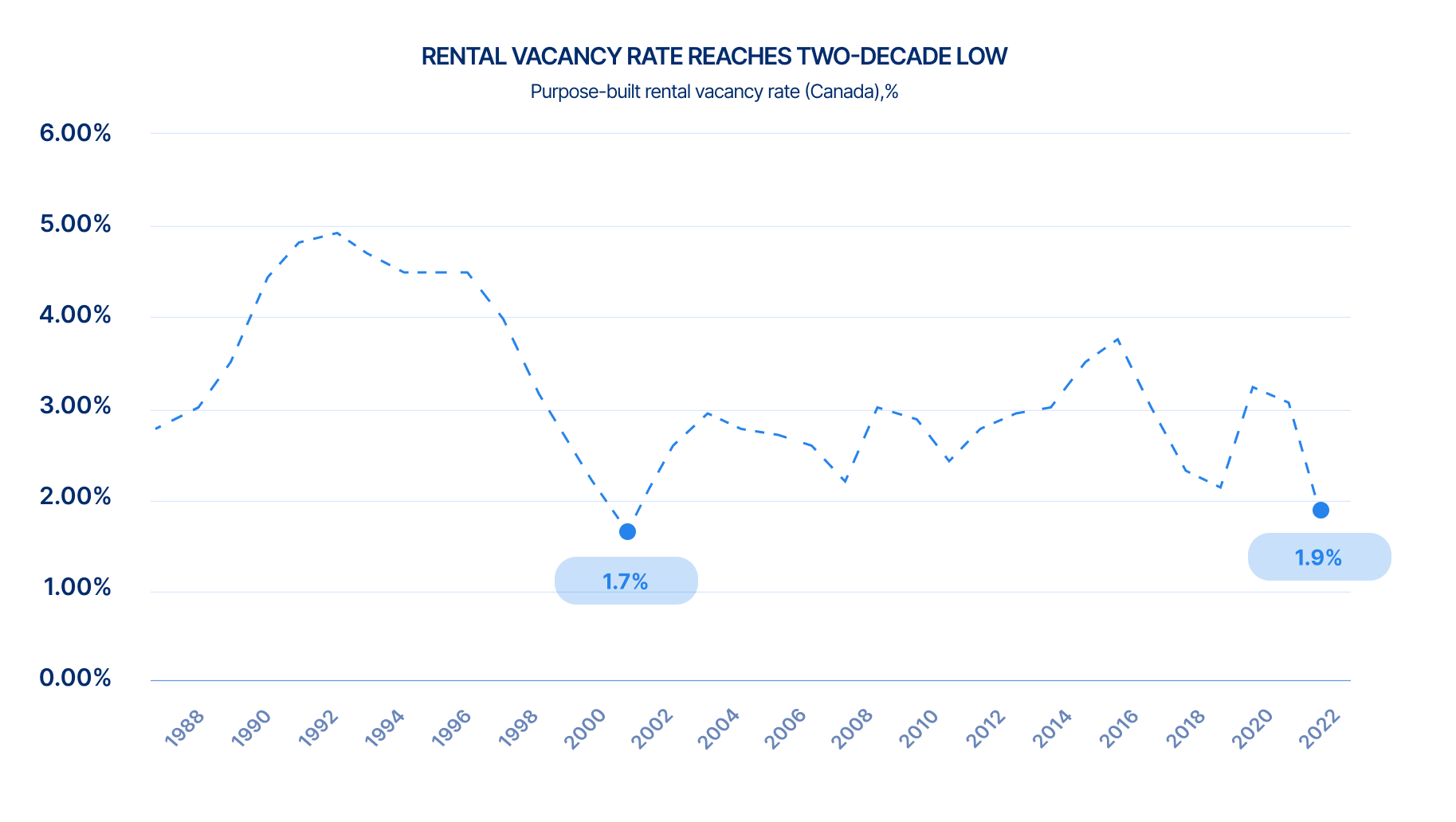
It's a pattern worth paying attention to. Today, Canada faces a comparable gap between the homes it needs and the homes being built – and history suggests that when supply falls behind, the consequences can escalate quickly.¹
Our Thesis Hasn’t Changed
This has always been Pier 4's thesis. By 2024, we were pointing to it directly: vacancy had fallen to 1.5%, its lowest level in over 35 years ⁷, while multifamily rents climbed 9.2% that same year, far outpacing wage growth.⁶
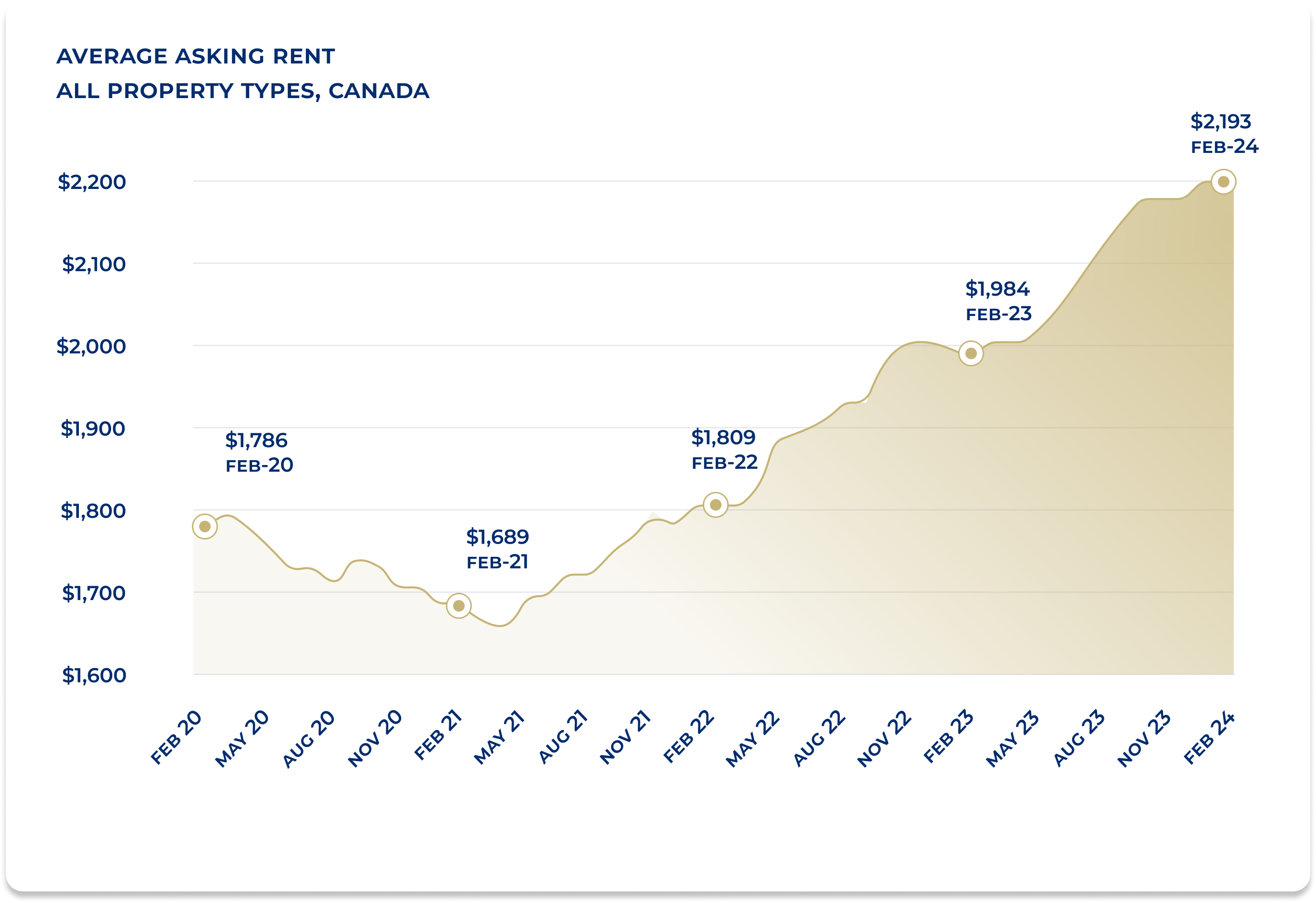
The market has evolved since Pier 4 first began highlighting these dynamics: rental supply has increased, and vacancy has moved away from those historic lows. But Canada still faces a substantial long-term housing requirement, and development economics and the future construction pipeline remain challenged.¹
That imbalance still exists today. Older and more affordable rental housing remains tight, and Canada's overall housing gap — now estimated at 187,000 to 238,000 homes annually — is as wide as it's ever been.¹ The market has evolved, and the specific numbers have shifted. But the structural imbalance Pier 4 has been focused on remains: Canada needs significantly more housing than its current development trajectory is expected to deliver.
6. Why Existing Apartments Matter More Than Ever
Building new housing remains essential. But existing apartment communities are already part of Canada’s housing supply, and many require continued investment to remain functional, competitive, and desirable places to live.
With the decline in housing starts and persistent development concerns, quality existing apartment communities are becoming more valuable and playing an increasingly critical role in addressing Canada’s housing shortage.
The importance of existing housing is also being reflected in investment activity. Canadian commercial real estate investment volume reached $25.4B in H1 2026, up 15% year-over-year across approximately 4,200 transactions.¹¹
As development remains challenged, capital continues to seek opportunities in existing real estate, including multifamily assets where occupancy, rental fundamentals and the ability to create value through active ownership remain attractive. Pier 4's strategy reflects that same logic.
Where Pier 4 fits in
For Pier 4, the opportunity is not simply to wait for new housing supply to be built. It is to invest in the apartment communities that Canadians already live in today.
Our strategy focuses on acquiring existing low-to-mid-rise multi-residential properties, in select secondary Canadian markets, where disciplined acquisitions can identify underperforming or under-rented assets with value-add potential. We then reinvest through targeted capital improvements, from building infrastructure to suites and common areas, while applying active, professional management to improve both the resident experience and the performance of the asset.
That discipline also informs where Pier 4 invests. Our expansion across Atlantic Canada reflects the same approach we apply nationally: identifying markets where rental fundamentals, acquisition opportunities and long-term demand support our investment criteria, rather than concentrating exclusively in Canada's largest urban centres.
This isn't a strategy built in response to current headlines. It reflects a thesis Pier 4 identified, and a strategy we've been executing, since our beginnings – before Canada's housing shortage became this prominent a part of the national conversation. Today, that strategy spans $535M+ in assets under management, across 55+ properties, 14+ communities, and 2,500+ units.
The result is investment in housing that already exists, supporting the communities Canadians live in today while working toward long-term value creation.
As Canada works to close its housing gap, opportunity lies in the homes Canadians already live in today.
SOURCES
1. Canada Mortgage and Housing Corporation (CMHC), Fall 2026 Housing Supply Report, September 2026.
2. CMHC, Housing Starts and Construction Data for July 2026, August 18, 2026.
3. CMHC, 2026 Mid-Year Rental Market Update, June 9, 2026.
4. CMHC, Housing Market Outlook 2026, February 10, 2026.
5. RBC Economics, "Proof Point: Canada's Shortage of Rental Housing Could Quadruple by 2026," 2023.
6. CBRE, "2024 Canada Real Estate Market Outlook," 2024.
7. Pier 4 Real Estate Investment Trust, Investor Presentation, July 2024, citing RBC, "It's Never Been Harder to Rent in Canada — Vacancy Rates Fall to 35-Year Low," 2024.
8. Pier 4 Real Estate Investment Trust, Investor Presentation, July 2024, citing Rentals.ca, May 2024 Update Rentals.ca Rent Report (data via Urbanation Inc.).
9. Pier 4 Real Estate Investment Trust, company metrics as of September 2026.
10. The Star, "PM looks at when to boost immigration as government gets system 'under control,'" September 2026.
11. Green Street News, September 23, 2026, citing CBRE Research.
12. The Globe and Mail, "Canadians most likely to give up on homeownership as housing costs force difficult trade-offs, global survey finds," October 2026.
Acquisition Post
